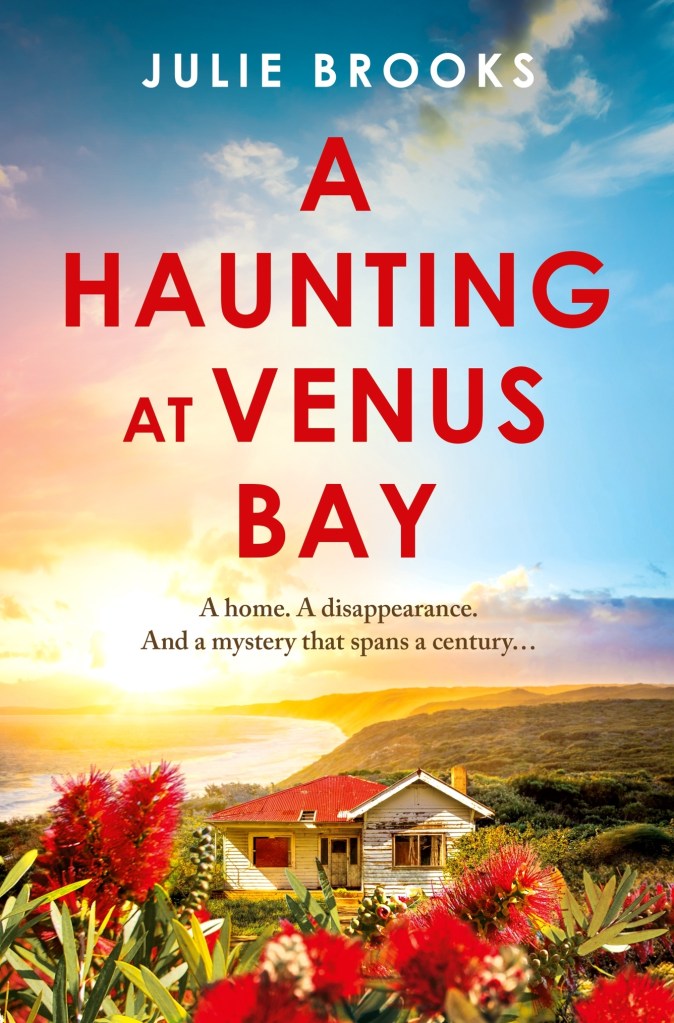
Cover Reveal — A Haunting at Venus Bay

I hope readers will love the cover of my new novel as much as I do. With its old house, a sweep of rugged coastline and an impenetrable thicket of coastal scrub, the cover reflects the story world perfectly. Set on Australia’s rugged south coast in the mid-twentieth century and the present day, it’s a tale of two women and the past that haunts them.

Two women, decades apart, and a house that brings them together.

When Cass leaves London with a fractured heart, she plans to settle in Australia, specifically in the beautiful area of Victoria coastline where she spent so many happy holidays. Yet when she arrives, her house is not quite what she’d envisaged – doing a place up is one thing, living with things that go bump in the night is quite another.

Years earlier, Minna and her mother have escaped war torn Europe to join the fairgrounds. There, Minna meets Albert, a man who wants a wife – but also a full-time worker on the farm near Venus Bay. Albert has no interest in Minna, nor tolerance of her desire to become a writer. When he, and then Minna, both disappear, the mystery of what has happened to them stays buried, seemingly for ever…

It will take Cass, and the discovery of a hidden book, to unravel the secrets of a childhood, a marriage, and a story that will help her live again.

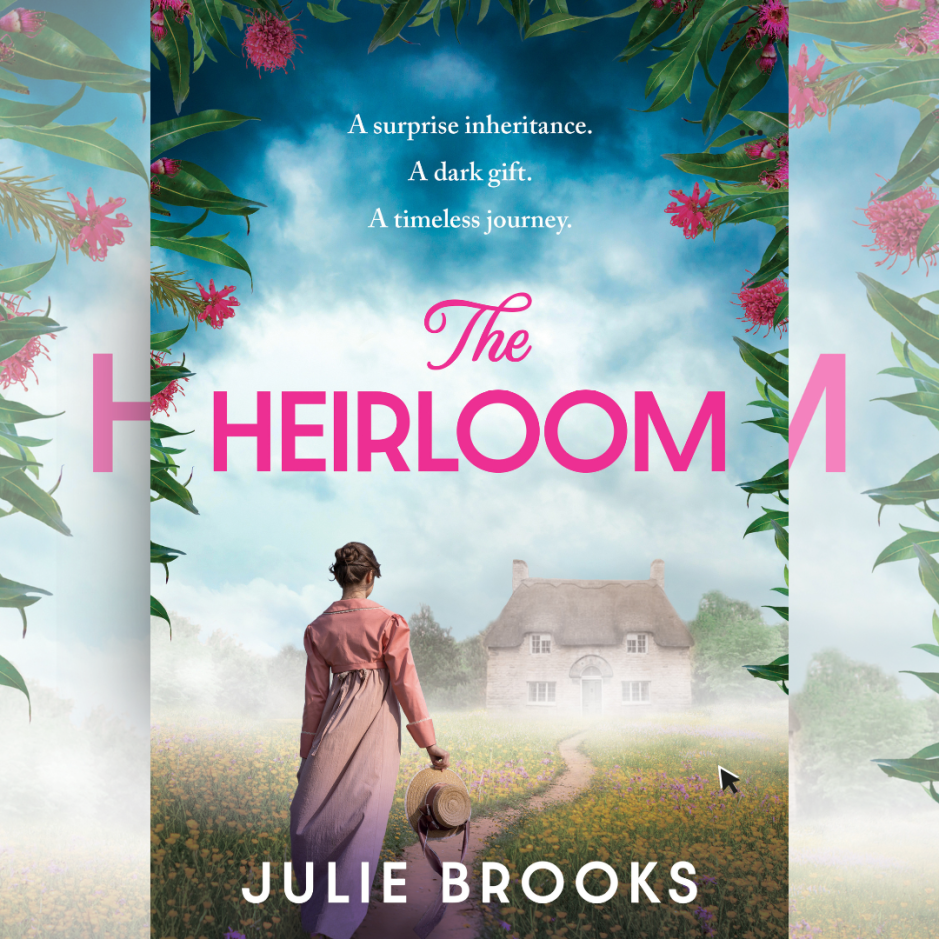
Cover Reveal — The Heirloom

I absolutely love the cover for my new novel The Heirloom and I hope readers will love it too. It sits perfectly with the covers of my previous novels with Headline but has its own mood and colours. Set in the early 19th century and the present day, its a story of magic and mystery in East Sussex and contemporary Brisbane.

A surprise inheritance. A hidden past.

Brisbane, 2024  Barista and budding artist Mia Curtis is shocked to receive a package all the way from England informing her she’s the heir to her late grandmother’s cottage. Feeling lost in her own life, Mia travels across the world to claim her inheritance, where she begins to unravel the secrets passed down through the generations of women in her family.

Sussex, 1821  Philadelphia Boadle wakes to find her husband, the tailor Jasper Boadle, dead. As the daughter of the local cunning woman, Philadelphia is soon accused of murder by witchcraft. Her future and that of her own daughter is at stake, unless she can convince the village she’s done no wrong…

https://geni.us/theheirloom

What I’ve Been Reading

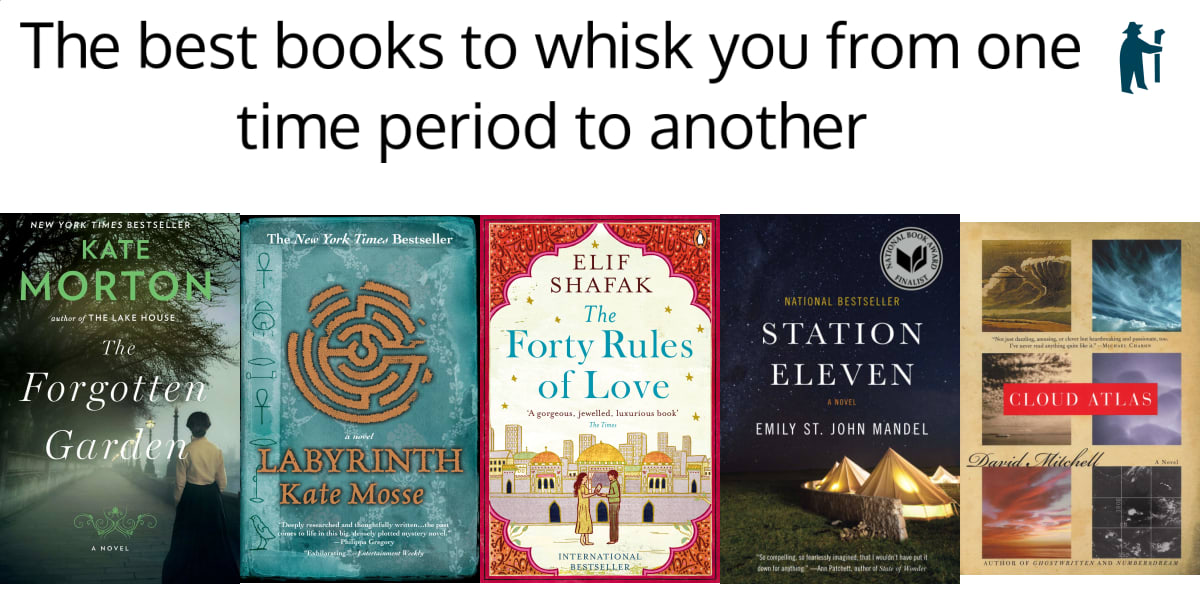
Shepherd.com invited 10,000+ authors and readers to share some of their favourite books in genres of their choosing. Search a genre, a mood, a theme or an author to discover what some of your favourite authors are reading. You can catch up on some of mine at:

https://shepherd.com/best-books/to-whisk-you-from-one-time-period-to-another

And if you’re looking to find out which books authors enjoyed in 2023, check out:

https://shepherd.com/bboy/2023

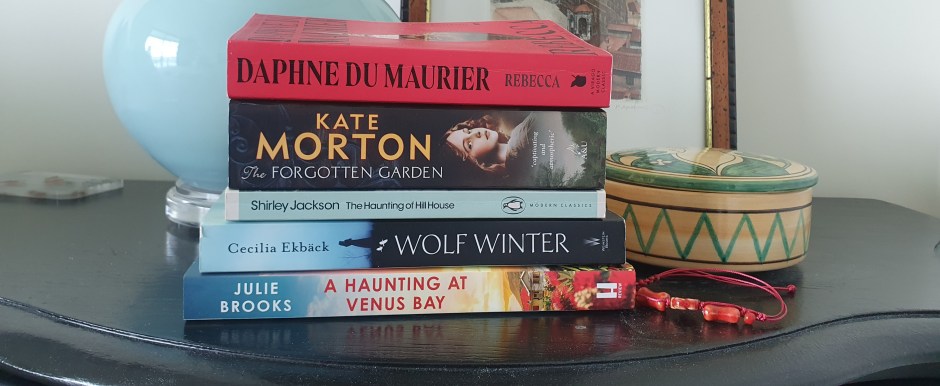
These are my most enjoyed novels of 2023:

https://shepherd.com/bboy/2023/f/julie-brooks

Work in Progress

It doesn’t have a title yet. Or a contract. But here’s a taste from the middle of the story (I don’t want to give too much away!) A dual-time story set in East Sussex in 1821 and Brisbane in 2024.

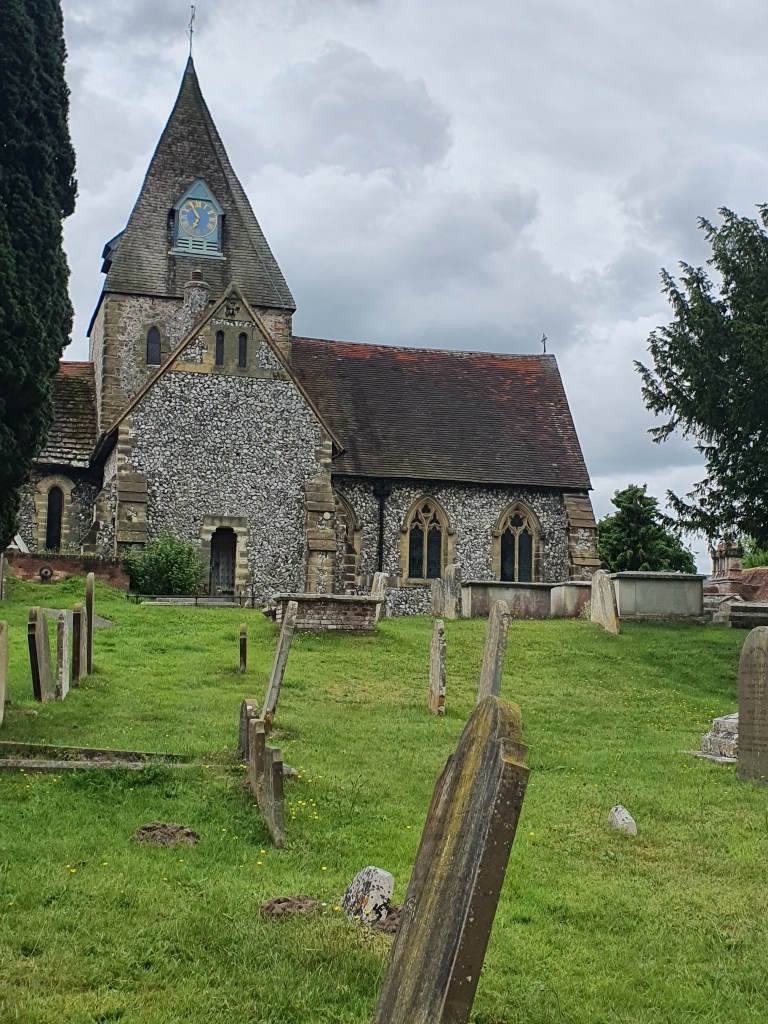
The gravestones loomed like grey shadows in the moonlight as she set out down the terraced slope. Some of the stones were ancient, etched with lichen, faded memorials remembering only nameless ghosts. Others belonged to people she had once known: women who had perished in childbirth; babies taken by the cholera; old men dead of apoplexy. And one, the earth only newly grown over, belonged to a lad not much older than her — dead after stepping on a rusty nail while shovelling manure in his master’s stable. They had brought him to her mother when the surgeon could not be found, but by then he was wracked with convulsions and the poultice of dried puffball she applied was too late to save him. Philadelphia had stood at her mother’s elbow ready to fetch whatever was needed, but no one could fetch a miracle.

It was to poor John Cooper’s grave she headed. It rested halfway down the slope; a cherry sapling sheltering it to one side while his infant sister’s grave lay to the other. Reaching it, she halted several yards distant and paused to remember the living boy and summon her courage. He’d had brown eyes with a crescent shaped scar hooking the corner of one eye. Right or left, she could not recall. But she remembered the way his thick brown hair flopped over his forehead and how he would flick it away with the back of his hand. He had given her an apple once, too perfect for any horses, so he said. She hoped that he rested in peace and would understand her intent.

Five Best Things About Being a Writer

Sometimes I can’t believe my luck that I get to do this unbelievable job and have people read my stories.

  1. Creating the story world

There are no wizards or warriors in my novels, but I do get to create my own worlds. They are as true to history as I can make them, yet still very much a product of my imagination. Like a bower bird, I pick and choose my favourite pieces to construct the story world. Sometimes the tiniest details tell the story more precisely than pages of description. In The Secrets of Bridgewater Bay, it is middle-aged Rose’s twinset and stockings and child Rose’s enormous collar flapping at her shoulders that tell us when the story is set as much as any date. Plus, I can call my main characters after my grandmothers if I feel like it. After all, I am the boss of my story world.

  1. Researching the facts

Research is so addictive that it can be difficult knowing when to stop. For The Secrets of Bridgewater Bay, I immersed myself in books about life in the trenches of World War One, the Voluntary Aid Detachment, grand country houses, passenger ships and early twentieth-century Sri Lanka. But not every fact needs to go into the novel. (Actually, readers will be relieved that ninety-nine percent wasn’t included.) Do my readers need to know everything about life in the trenches? Probably not. But knowing that the men were shipped about ‘like livestock in horseboxes labelled “40 hommes, 8 cheveux”’, and spent ‘half their day hunting lice from their clothes and the other half chasing rats’ gives them a pretty good idea.

  1. Planning the puzzle

Every novel is a puzzle. Somewhere near the beginning, the writer poses a central story question that the reader will want answered. In The Secrets of Bridgewater Bay that question is ‘What happened to Rose?’. So how to create the puzzle the reader must solve to answer that question? It’s all part of the fun.

  1. Engaging the reader

Speaking of puzzles, I’m not a writer who wants the answer to come as a total shock. Actually, when I read a novel where the person who ‘dunnit’ hardly features in the story I feel cheated. I love that writer and reader go on a journey together where the writer plants the clues and the reader finds them. Maybe they’ll guess the answer then a later clue will leave them doubting that guess, often several times over. It’s the twists that matter.

  1. Holding the book in my hands

Oh, that moment when the box of author copies arrives and I hold my amazing new book in my hands for the first time. I can’t resist sniffing the pages, running my hands over the jacket and turning the book this way and that so the light catches the pretty colours. And then I think about all the people involved in creating this lovely thing and all the people who will read it and I feel privileged to be a writer.

Cover Reveal — The Keepsake

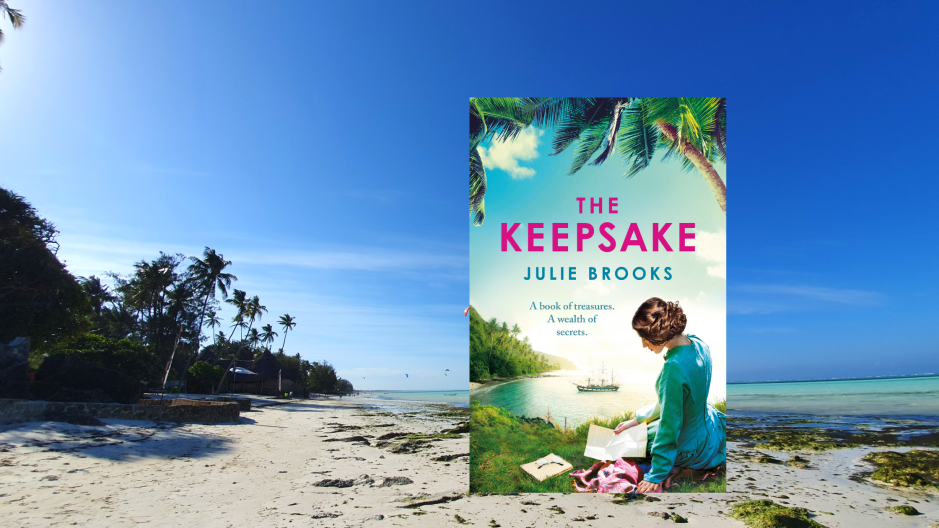
The moment when your editor sends you a visual for your next book’s cover has to be one of the most fun parts of a writer’s job. And here it is, the stunning artwork for my next novel The Keepsake.

Saturday: Pot-au-feu for luncheon. Father willed away inheritance. Betrayed by Edward.

The Keepsake

1832. The morning after her father’s funeral, Prudence Merryfield wakes to the liberating thought that this is the first day of her new life. At thirty-five and unmarried, she is now mistress of her own fate. But a cruel revelation at the reading of her father’s will forces Prudence to realise that taking only the most drastic action will set her free. 

Present day. Eliza is gifted a family heirloom by her aunt – a Georgian pocket book, belonging to her ancestor, Prudence Merryfield, whose existence reverberates through the lives of generations of Eliza’s family, the Ambroses. Intrigued by what she reads inside, Eliza is drawn more and more into the infamous ‘Merryfield Mystery’. What happened to Prudence who so bravely dared to defy convention two hundred years ago – then disappeared?

Ebook and Audio available 29 September 2022.Hardback and trade paperback available January 2023. order now using the link below.

http://smarturl.it/TKJB

The Secrets of Bridgewater Bay

Two women set sail bound by a terrible truth but only one will arrive.

My latest novel The Secrets of Bridgewater Bay is a darkly gripping, dual-time novel, with a wealth of twists, turns and secrets.

England, 1919:

Rose and ivy board a ship for Australia. One is travelling there to marry a man she has never met. One is destined never to arrive.

Australia, 2016:

Amongst her late grandmother’s possessions, Molly uncovers a photograph of two girls dressed in First World War nurses’ uniforms, labelled ‘Rose and Ivy 1917’, and a letter from her grandmother asking her to find out what happened to her own mother Rose, who disappeared in the 1960s.

Compelled to carry out her grandmother’s last wish, Molly embarks on a journey to England to unravel the mystery of the two girls whose photograph promised they’d be ‘together forever’…

Out now in ebook, audiobook and print.

Praise for The secrets of bridgewater bay

I thoroughly enjoyed this immersive story which spans both generations and continents. The evocative details and impeccable research make for a delightful reading experience and I can pay it no greater compliment other than to say, I wish I’d written it‘ KATHRYN HUGHES

‘A sweeping tale of family secrets, betrayal, jealousy, ambition and forbidden romance . . . Fans of The Thorn Birds and Downton Abbey will love the epic scope of this novel’ ALI MERCER

‘This is an epic dual-time novel which draws the reader in right from the start and keeps you in thrall until the very last page. The writing is superb, the descriptions detailed, lush and evocative’ CHRISTINA COURTENAY

‘A gripping story full of family secrets: the price of love and loss within two generations . . . convincing and poignant’ LEAH FLEMING

‘Rich in evocative detail – the complex mystery kept me guessing right up to the last page’ MUNA SHEHADI

Inspiration Wall

A vista of images is more inspiring than a blank wall for this writer.

As a writer of historical fiction I am always collecting images as part of my research. Maps, plans, photographs, drawings and paintings, all form part of my collection. I file some in topic folders with other clippings and print-outs of reference material, but others I blu-tack to the the wall my desk faces as a constant reference and source of inspiration.

If you look closely at the photographs on this page you’ll see a central image of two WW1 nurses that was an early source of inspiration for The Secrets of Bridgewater Bay. In a way, this photograph set the mood for the entire novel. And around it I added other images that became integral to the story.

She turned the photograph over to read aloud the words penned in faded blue on the rear, ‘Rose and Ivy 1917’…Below that, scrawled in a more haphazard hand were the words ‘Together forever’.

The Secrets of Bridgewater Bay

Some are photographs I took myself, of locations that appear in the novel. Others are historical photographs of people, places and objects from the early years of the 20th century when the novel is set. Clothing, cars, houses, ships, even a doll’s house that caught my attention and demanded to be included in the story. Of particular inspiration to the mood of the novel were the historical photographs of Colombo in Sri Lanka and Port Said, Egypt. Whenever I felt lost, uncertain where the story needed to go next, or not feeling very inspired, my wall of images lured me back.

Say farewell to one wall and hullo to the next

As I write, I am about to begin a wall for a new story. Be prepared for Sussex cottages, Regency dresses and the mighty Brisbane River.

Writing Historical Fiction

People often ask how authors motivate themselves when working so much alone, particularly if they have no looming deadline. As a writer of historical fiction, one of my tactics is to read myself into motivation. In the early stages of a new book idea I don’t have the impetus of lots of words already written to get me going, so I turn to other authors’ words (usually nonfiction) to inspire my creativity. Prod it along, so to speak. Inevitably an idea strikes. In other words, for me reading = writing.

For me, reading = writing

Here is a stack of books I turned to when writing my latest novel The Secrets of Bridgewater Bay. Perhaps the titles will give you a few clues as to its setting. If you sense that the book covers quite a bit of territory, you’d be right. Set in the early twentieth century, it moves from a grand country house in Devon, England, to a homestead in rural Australia. Life in the English Country House and Historic Homesteads are both excellent pictorial references that helped me envisage these settings. And Servants was an excellent resource to understand the relationship between ‘upstairs’ and ‘downstairs’ at that time.

Along the way, the characters travel by ship through the Suez Canal, sailing via Colombo, Sri Lanka, before reaching Australia. Two Happy Years in Ceylon is a reprinted travelogue from the late nineteenth-century, and a treasure trove of description about Sri Lanka at that time from an English traveller’s perspective.

And although the novel isn’t set on the battlefields of World War One, the characters’ lives are impacted by these events. Hence, Vera Brittain’s must-read Testament of Youth, Juliet Nicholson’s The Great Silence and several wonderful and moving collections of letters and diaries by Australian soldiers, which helped give an authentic voice to some of the passages in the novel.

There were many more books, of course, plus a myriad of online sources. But these were a few that really helped me through some rough patches in the writing process.

Revision

Revision…

Some writers hate revising but it’s my favourite part of the writing process. It means I’ve done the hardest part – conquered the blank page.

So here I am, at my final draft before I submit the manuscript for my next book to my editor, and I’m working with hard copy again. This time I’ve printed the manuscript on green paper to trick me into seeing it with fresh eyes. And it has caused me to rethink my first page completely. Actually, it has caused me to rethink the entire first chapter.

It has also prompted me to cut swathes of writing that I previously thought quite brilliant. I thought I’d already done a structural edit and a line edit so the story was dressed and ready to walk out the door. But no…

Re-reading in hard copy (aloud until my throat began protesting) can give the writer an entirely new perspective so that you see things you didn’t notice on the screen. I suspect that’s because it’s closer to the experience of reading a finished book. This is especially so if you don’t fiddle with the little things on that reading. Just consider the story’s pace and flow and mood.

And do put the manuscript aside for a couple of weeks before you begin the process.